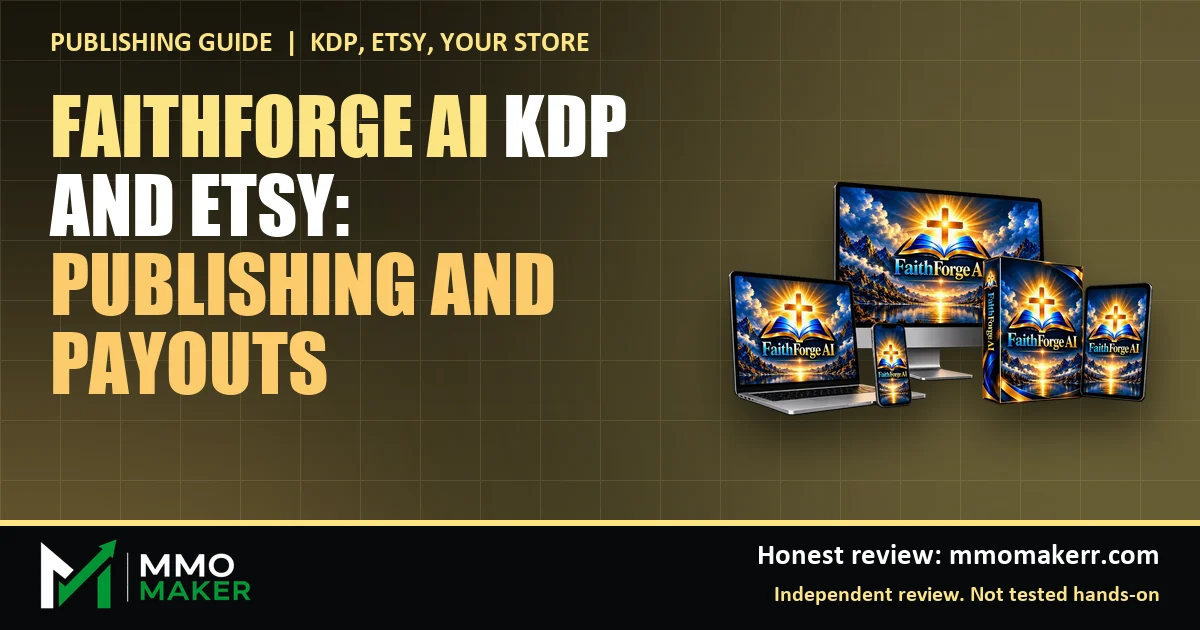
FaithForge AI KDP publishing is the question most buyers reach after the first devotional is drafted: once the content exists, how does it actually get onto Amazon, into an Etsy shop or into your own store, and who gets paid?
FaithForge AI is a web platform from Peter Onwe that, per the vendor, writes faith content from a topic or verse, looks up each Bible verse word for word, and then helps you publish it to your own site and store or export it for Amazon and Etsy. This guide walks through each route using only what the vendor’s own pages say, and points out where those pages disagree. For the full product picture, price and upgrades, read our FaithForge AI review.
MMO Maker is an affiliate for FaithForge AI and earns a commission on purchases through our links, at no extra cost to you, in line with the FTC’s endorsement guidelines. That does not change what we write here. Everything about the product comes from the vendor’s own sales page, JV page, JV documentation and checkout pages, and we have not tested it hands-on.
FaithForge AI KDP and Etsy: the short answer
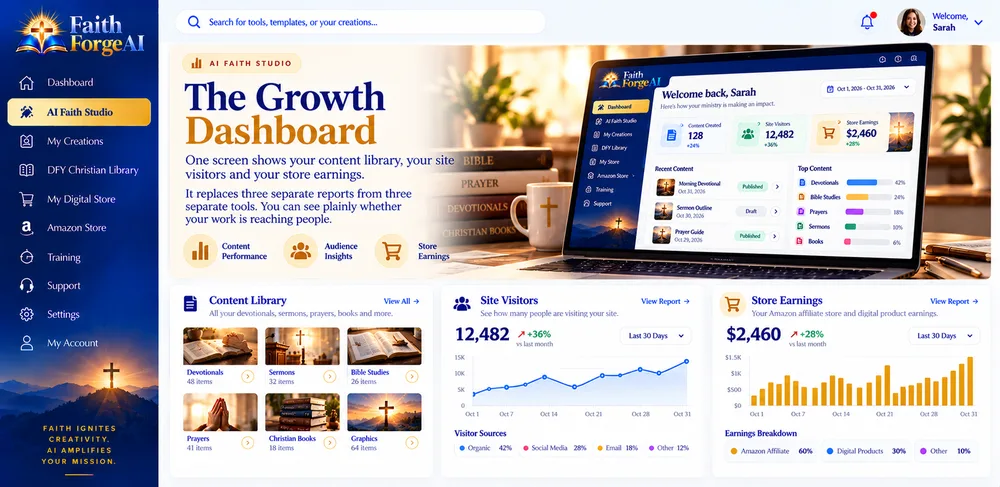
Treat FaithForge AI as the place where content is written, checked and packaged, and treat Amazon KDP, Etsy and your own store as separate shops that you run yourself. The vendor describes three ways to get paid from what you create: export finished documents for Amazon and Etsy, sell digital products in a built-in store that pays into your own account, and run an Amazon affiliate faith store with your own affiliate tag.
None of those routes brings readers or buyers by itself. A content platform makes the content. Getting it seen is still your job, and nothing is guaranteed to sell.
What happens after you click create
Per the vendor, the flow has three steps. You choose a topic, a verse or an occasion and set your church tradition and tone. You click create, and the first draft is ready in under a minute, with every verse looked up from the New Living Translation instead of being recalled by the AI. Then you read it, change what you like and approve it, because nothing goes out until you do.
The vendor lists ten creators: devotionals, sermons, Bible studies, prayers, Christian books, quotes, verse posts, reels scripts, newsletters and sales copy. For FaithForge AI KDP and Etsy products, the ones that matter most are the books, devotionals, study guides and printables. Our guide to checking Bible verses in AI devotionals covers the review step you should run on every one of them.
Publish or export? What the vendor’s pages actually say
This is the most important detail in any FaithForge AI KDP plan, and the vendor’s own pages do not agree on it. The sales page FAQ says the platform publishes to Amazon, Etsy and other platforms. The vendor’s workflow, on the same page, says you export a finished document for places like Amazon and Etsy.
Publishing would mean the tool sends your book to KDP for you. Exporting means you download a file and upload it yourself. The safe assumption, until you see otherwise inside the product, is the second one: you will upload every book and every Etsy listing by hand. Budget the time for it, because each listing needs a title, a description, keywords, a price and a cover that you check yourself.
FaithForge AI KDP books: what you still do yourself
Even with a finished file, a FaithForge AI KDP book needs work that no tool does for you. Here is the list we would follow:
- Open your own KDP account and complete the tax and payment details Amazon asks for.
- Read the exported file from the first page to the last. Check every verse against your own Bible and check the doctrine for your tradition.
- Check the layout on Amazon’s own previewer before you publish, whatever the export looks like on screen.
- Write a description that tells a reader what they get, without promises the book cannot keep.
- Choose a price and categories, then order a proof copy if it is a paperback.
The vendor says the front end includes commercial rights and that you keep 100% of your sales. On Amazon, that means you keep what Amazon pays you as royalties under its own terms. FaithForge AI does not change Amazon’s royalty rules.
FaithForge AI KDP and the AI disclosure question
The vendor itself says Amazon now asks publishers to disclose AI-generated content, and advises being open about how you made your work. That is a useful thing for a vendor to say, and it is also the part of any FaithForge AI KDP plan that can change without notice.
Before every upload, read Amazon’s current KDP content guidelines, including what they say about AI-generated content and how to answer the question in the publishing form. Breaking the rules can put a book or an account at risk, which is a far bigger loss than the time it takes to read them.
Selling FaithForge AI printables and journals on Etsy
The vendor lists journals, printables and templates among the products you can create, and says you can export them for Etsy. Etsy is a good fit for digital downloads such as prayer journals, scripture cards and weekly devotional planners, but it is a separate shop with its own fees, listing rules and policies.
Three practical points for FaithForge AI Etsy listings. First, every listing needs your own photos or mockups that show exactly what the buyer downloads. Second, read Etsy’s current seller policy before you list, including anything it says about how items are made. Third, start with five listings, not fifty, so you can see what people search for and what they buy.
Your own store: where the money goes
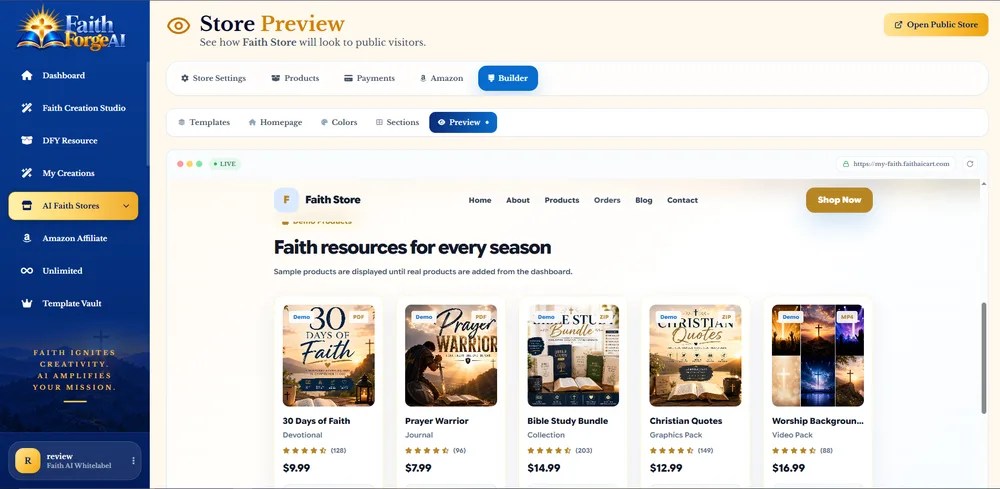
The third route skips the marketplaces. Per the vendor, FaithForge AI includes a digital product store for ebooks, devotionals, journals and templates. Buyers pay into your own Stripe, PayPal or bank account, and the vendor says it never touches your money.
That is the right design for a seller, because the money is in your account from the start. It also means the customer relationship is yours: refunds, support emails and any tax you owe on sales are your responsibility, not the vendor’s. The vendor also lists a Faith Store and Monetization Suite upgrade at $97, so check what the front-end store already does before you consider it.
The Amazon affiliate faith store
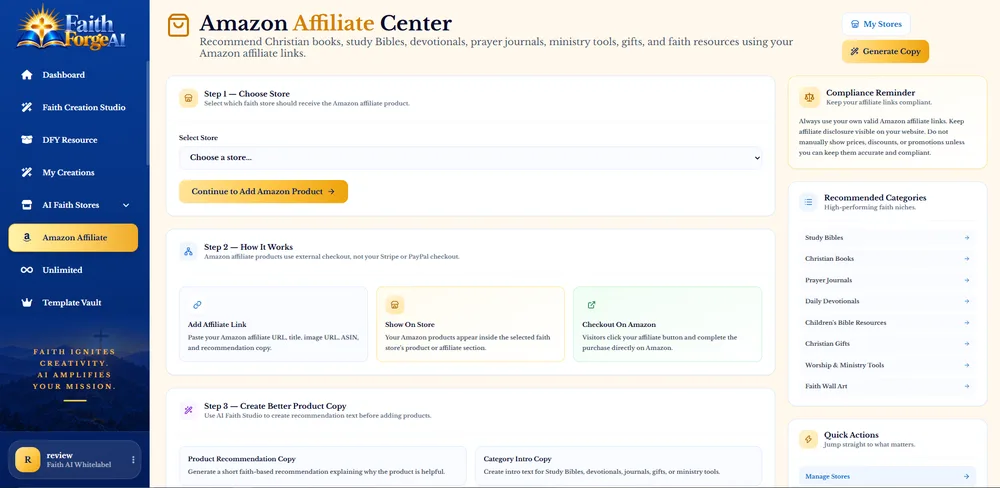
Separately from publishing your own books, the vendor lists an Amazon affiliate faith store: a ready-made storefront of Christian books, study Bibles and gifts that uses your own affiliate tag. You earn a commission when someone buys through it, under Amazon’s own affiliate terms. Read those terms, and disclose the affiliate link on every page that shows it.
Your own domain and the website builder
Per the vendor, the no-code faith website builder makes a ministry site, blog, author site or resource hub on a free subdomain or your own domain. For an author selling FaithForge AI KDP books, an author site on your own domain is worth having, because it is the one place you fully control and it gives readers somewhere to find your next book.
The JV page also lists Ministry Website Pro at $97. The vendor does not spell out exactly what it adds over the front-end builder, so ask support before you pay. Our FaithForge AI OTO guide goes through every upgrade and which ones most people can skip.
Pen names: publishing behind the scenes
The vendor says there is a pen name option, so you can stay behind the scenes. That suits people who want to serve readers without building a personal brand. Two cautions apply to any FaithForge AI KDP or Etsy plan with a pen name: marketplaces can still ask for your legal name for payment and tax, and a pen name is not a reason to skip the disclosure question above. Readers of faith content care about trust, so keep the author voice honest.
Audio and podcasts: the Spoken Word Engine
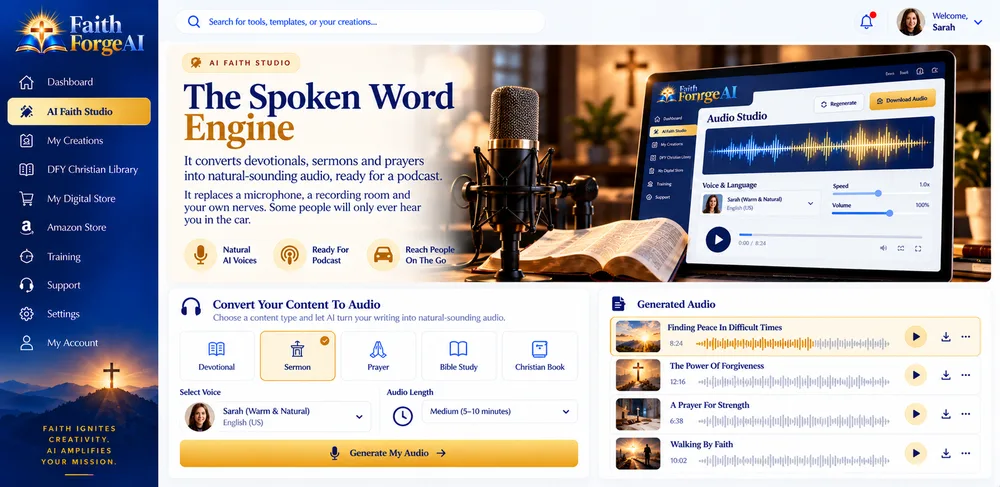
The front end lists a Spoken Word Engine that turns devotionals, sermons and prayers into natural-sounding audio for people who would rather listen than read, per the vendor. That can become an audio companion to a devotional, a short daily prayer track or the raw material for a podcast.
Hosting and publishing a podcast is a separate step on a podcast host. The vendor also sells a Faith Audio and Podcast Creator upgrade at $77, and says little about what it adds beyond the front-end engine, so test the included audio first.
Limits, upgrades and what the front end includes
Here the vendor’s pages pull in two directions. The front-end sales page says there is no limit on how many assets you can create, yet the first upgrade is called Unlimited Creation at $97. If you plan a large FaithForge AI KDP catalogue, ask support in writing what the front-end limits are before you build around them.
Several other front-end features have a similarly named upgrade: graphics and reels, audio, scheduling, templates, the website and the store. The vendor does not spell out the difference for each, so the honest plan is to use the front end for a week, note the exact limit you hit, and only then decide. The vendor states a 30-day refund, which is the window to make that test.
Price, coupons and the refund
Per the vendor, the front end was $17 one-time at checkout during the launch, with an order bump and 11 optional upgrades after it. The JV documentation lists the coupon code Forge30off and the sales page lists FFAI3. The launch cart closed on October 17, 2026, per the JV doc, so check the price and terms on the checkout page today rather than relying on launch-week figures.
A FaithForge AI KDP checklist before your first upload
- Create one devotional or short book in your own tradition.
- Check every verse and every doctrinal word yourself.
- Export it and open the file on another device.
- Read Amazon’s KDP content guidelines and answer the AI question honestly.
- Upload one book and five Etsy listings, not fifty.
- Connect your own Stripe or PayPal before you open the store.
- Ask support about front-end limits before buying any upgrade.
- Decide inside the 30-day refund window.
Comparing FaithForge AI with other ways to earn online? See our guide to the best AI tools for making money online.
FaithForge AI KDP and Etsy: frequently asked questions
Does FaithForge AI publish straight to Amazon KDP?
Not as far as the vendor’s own pages show. The sales page FAQ says the platform publishes to Amazon, Etsy and other platforms, but the vendor’s step-by-step workflow says you export finished documents for them. For a FaithForge AI KDP book, plan to upload the files yourself.
Can I sell FaithForge AI content on Etsy?
The vendor says you can export finished documents for Etsy and that the front end includes commercial rights. You still open and run your own Etsy shop, set your prices and follow Etsy’s current seller rules and fees.
Where does the money from my FaithForge AI store go?
Per the vendor, buyers in the built-in store pay into your own Stripe, PayPal or bank account, and the vendor says it never touches your money. Amazon and Etsy pay you through their own systems, not through FaithForge AI.
Can I use my own domain?
The vendor says the no-code website builder works on a free subdomain or your own domain. There is also a Ministry Website Pro upgrade at $97 on the JV page, so ask support what the front end covers before you pay for it.
Can I publish under a pen name?
Yes, per the vendor, there is a pen name option. Marketplaces can still ask for your legal details for payment and tax, so check each platform’s account rules.
What happens when I reach a creation limit?
The vendor’s sales page says there is no limit on how many assets you can create on the front end, yet the first upgrade is called Unlimited Creation ($97). The vendor does not spell out the front-end limits, so ask support before you build a big catalogue.
Can I turn my content into a podcast?
The front end lists a Spoken Word Engine that turns devotionals, sermons and prayers into audio, per the vendor. Hosting and publishing a podcast is a separate step, and there is a Faith Audio and Podcast Creator upgrade at $77 for deeper audio tools.
Is FaithForge AI KDP publishing allowed?
That depends on Amazon’s current rules, not on the tool. The vendor itself says Amazon asks publishers to disclose AI-generated content. Read the KDP content guidelines before every upload, and edit and check every book yourself.